How bears domesticate humans
- Kristína Jamrichová works at the intersection of social science research and art. Besides researching institutional biopolitics, she is currently exploring topics related to the (post-)Anthropocene and the dialectic of the "natural" and the "technical." Between 2018 and 2022, she was part of interdisciplinary projects focused on housing policy and design for the third sector. She now works as an assistant professor in the Department of Design and heads the Fine Art and Design program’s studio at FFA BUT, Brno.
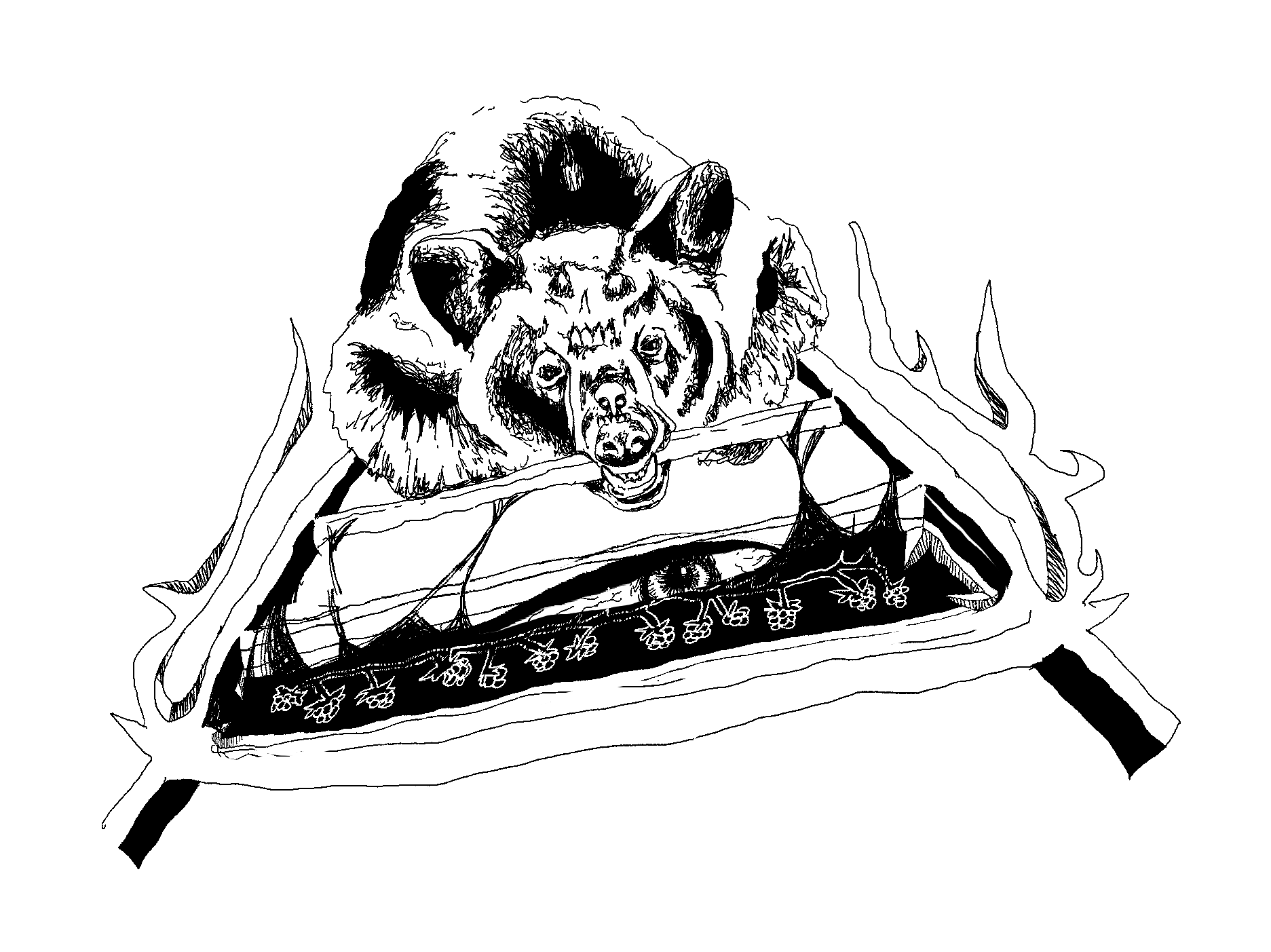
The female bear that injured five people in Liptovský Mikuláš was shot dead on Tuesday evening, 26 March 2024. The Slovak Minister of the Environment, Tomáš Taraba, reported on social media that a drone equipped with biometric sensors had been used to identify the animal. Following the attack, the intervention team organised 24-hour patrols in cooperation with other security forces. The State Nature Conservation Agency of the Slovak Republic (ŠOP SR) installed camera traps in selected areas to track the movements of the three-year-old bear, which weighed almost 70 kilograms. This enabled the drones to compare photographic documentation of the bear with images captured during previous observations. This was the first time that the ŠOP intervention team had utilised this identification technology. The primary objectives were to ensure the safety, health and property of residents, and to prevent the problematic individual from returning to the built-up area.1
The Slovak brown bear population represents a unique genetic lineage that is partially isolated from the rest of the Carpathian arc. This omnivorous opportunist has been protected by law since 1932, when it was almost driven to extinction. Nevertheless, the protection of the species and its very existence have been the subject of heated public debate and election campaigns in recent years. This is due to the alleged overpopulation of brown bears, which is considered to be the reason for an increase in dangerous encounters with humans. This issue has become of interest to many stakeholders, including ordinary citizens, high-ranking politicians, hunters, foresters and developers pursuing commercial interests. However, the issue of overpopulation has also been discussed within professional zoological and conservation communities for some time.
There is not enough space in this text to address the amateurism and lack of moral integrity of authoritarian politicians, led by the Environment Minister and the Minister of Tourism and Sport. Both ministers were appointed by the Slovak National Party and have been pushing for drastic measures against the brown bear population since their time as members of parliament, including blanket population reduction and random culling.2 The latter politician is not only a long-standing member of the Slovak Chamber of Hunting but also its chairman of the shooting commission.3
The text is not a case study; it is closest to the genre of an essay and could serve as preliminary reflections and hypotheses on the issue4 before proper field research is conducted. From a certain post-humanist position,5 I attempt to formulate objections to two themes that have become entrenched in public discourse — both virtual and real — in recent years, providing 'objective' reasons for the escalation of the bear situation. The first is the 'overpopulation' of bears, and the second is the category of so-called 'problematic individuals'. Based on my ongoing analysis of narratives concerning the brown bear in Slovak media, I believe these categories, as products of various scientific and political discourses, are widely used or misused by disciplinary and even fascist policies. Thus, on the one hand, I dispute their relevance to truth, but on the other, in this essay, I call for attention to be paid to what these narratives about bears ultimately do, what reality they create.
It is against the backdrop of the current debate on (wild) animals in the Anthropocene that I reflect on narratives about overpopulation and problematic individuals. In this interdisciplinary discussion,6 we often encounter ecological terms with more or less negative connotations, such as 'synanthropisation', 'loss of shyness', and 'problematic individual', as well as positive concepts such as 'rewilding'.7 A neologism analogous to synanthropy, known as 'ferality',8 has recently become established in social science and related fields. And yet, they cannot be considered synonyms. While synanthropy refers to living organisms adapting to human infrastructure, ferality requires us to consider both non-human agencies — including non-living ones — and the human arrangements that generate them. 9
The terms 'synanthropic' and 'feral' both refer to a bear that is no longer shy. We cannot be sure that they will stay deep in the forest, eating blueberries or hibernating, far from us. It's not just about rubbish bins. Near human settlements, bears now find new, attractive food sources, such as high-energy maize. Due to climate change, maize cultivation is spreading to sub-mountainous regions where it was not traditionally grown. Bears are also attracted by changes in the landscape, such as the decline of farming and grazing, overgrown agricultural land, abandoned settlements, and new thickets.10 'Infrastructures produce feral effects because they modify land, water, and air, causing responses from all the beings that encounter these modifications.'11 A synanthropic bear feeds on rubbish from containers or maize near settlements, thereby endangering people. A feral bear is created by human waste disposal infrastructure resulting from overproduction and waste, or by climate change, allowing maize to be grown in the foothills.
However, bears that approach humans are primarily presented as a problem that can be most easily framed within a narrative of overpopulation, offering an apparently 'easy' solution. Radical procedures primarily originate in nationalist circles, which are generally known in the European context for lobbying against environmentally sensitive policies. As Elizabeth Povinelli emphasises, 'it is not humans who have exerted such malignant force on the meteorological, geological, and biological dimension of the earth but only some modes of human sociality'.12 It will be necessary to distinguish between one sort of human and its modes of existence from another in this story as well. In addition to the relentless policies of blanket culling, preliminary mapping has identified advocates of so-called regulated culling and initiatives calling for the introduction of non-lethal policies, which, according to them, are supported by data from other countries and actually reduce the number of risky situations.13
Upon deeper reflection on the recurring pattern of nationalist offensives against wild carnivores, we realise that, logically, these animals could instead be embraced as a form of 'national natural heritage'. However, only the shy bear — the noble savage rarely glimpsed by the human eye — could fulfil this role. When a bear approaches, it soon becomes an enemy, albeit a useful one for the paternalistic nation-state. In Germany, for example, the right-wing political party Alternative for Germany (Alternative für Deutschland) has adopted a similar stance on 'dangerous wolves'. They emphasise the protection of citizens and advocate 'wolf quotas', as anthropologist Lukáš Senft writes in his master's thesis on wolves in the Broumov region.14 Senft points to an analogy with Czech wolves, which the fascist and Eurosceptic party Freedom and Direct Democracy15 uses to gain political points by also calling for the deregulation of culling.
German geographer Julia Poerting argues that the AfD's rhetoric on wolves is strikingly similar to the party's rhetoric on refugees.16 Similarly, Boesel and Alexander demonstrate that, in North America, the social mechanisms that generate violence against coyotes and the structures that oppress certain groups in favor of the supposed humanity of others work together.17 Ananya Roy also claims that the same logic of eviction or displacement applies to African Americans, homeless people, and coyotes. This suggests that the spatial issues underlying these debates about inconvenient animals are part of a broader human project of excluding 'otherness'.18 However, within this project, the same methods of exclusion are not applied to animals and humans alike. In the case of animals, humans are often not particularly averse to designing methods of exclusion that amount to physical extermination. In the Slovak context last year, we witnessed explicit efforts to include the possibility of a blanket cull of the brown bear population in the constitution. These voices again came from the ranks of the coalition’s nationalist populists. Although the constitutional bill was ultimately not passed, an amendment to the Nature Conservation Act19 drafted by an opposition party introduced the possibility of declaring a state of emergency in a municipality as the sole condition for culling outside of administrative proceedings.20
Conversely, the Slovak bear cannot be viewed merely as a passive subject of human control; rather, it actively influences processes that affect human behaviour.21 For example, the female bear mentioned at the beginning of this essay prompted the development of the tracking and identification apparatus used by the state nature conservancy. The bear's crossing of the city boundary also fuelled the media and political witch-hunt. While the physical bear was shot, her digital avatar22 was created at the moment of her death. According to the My sme les (We are the Forest) initiative, fewer than 30 articles about bears were published in the Slovak media in 2013. That year, there were six bear attacks on humans. By 2024, an astonishing 2,483 articles about bears had been published, despite only 11 attacks occurring. Nowadays, several media outlets report on a single sighting or attack. In addition, thousands of people share this news on social networks. This creates the impression that bears are suddenly everywhere and are causing daily problems.23
However, it does not stop at perceptions. The authors of last year's study, which was based on long-term research into the negotiation of human–coyote relations in Los Angeles, demonstrate that the so-called 'cloud coyote' — a collectively created and shared coyote that exists independently of the real animal in digital space — is more than just a representation. It has direct ontological consequences for real coyotes. According to the authors, cloud coyotes co-create the structure of ecological relations in contemporary Los Angeles. They do this by embodying a threat and justifying a response that includes various attempts at eradication, isolation, and assimilation.24 Similarly, the affectivity of the 'virtual bear' retroactively informs the policies of the real bear, which are increasingly characterised by the prefix 'necro' rather than 'bio'. Examples include the use of new tracking technologies for the purpose of shooting an animal, rather than the preventive use of GPS collars on bears that roam near human settlements.25
The network of relationships in which both virtual and real bears are collectively shaped can only be revealed through ethnographic research. In this essay, we can only assume the complexity of this network and acknowledge its active exploitation by political entities that successfully mobilize political capital through the animal and legitimise state militantism under the guise of protecting the population. In practice, however, this means that the discourse of deregulated culling is materialising in the hands of the state's executive power.
Even disregarding the political exploitation of bears and the legitimisation of hunting them for ideological, populist or economic reasons,26 authorities with influence over decision-making processes show little imagination in devising alternative bear policies. Alongside extreme proposals for widespread culling in recent years, more moderate voices in the media space have called for regulated hunting at the interface between human settlements and the core of the biotope, so that bears understand that humans pose a danger and conflict encounters are prevented.27 These voices primarily work with the paradigm of the 'problematic individual'. This paradigm assumes that individuals who have once exhibited conflict behaviour are more likely to repeat it than their 'blameless' peers.28 However, extensive research in the Polish context has shown that this assumption is flawed, as there is no causal relationship between 'catching an animal in the act' and the persistence of the behaviour in question, even when no steps are taken to eliminate the 'problematic' behaviour. Therefore, animals that have caused one-off damage to humans should not be automatically labelled as 'problematic individuals'. The overuse of this label, even when applied to individuals who have ever caused harm to humans, has a direct impact on species protection through management decisions and negatively affects public opinion.29 Similarly harmful is the framing of relations between humans and bears as a 'conflict', as this concept turns wildlife into conscious antagonists of humans.30 These categories, therefore, do not merely function as representations but actively participate in reality.
Why is the management of protected bears even conceivable within a necropolitical regime, even among professionals? Experience from other countries shows that hunting, particularly the selective lethal management of 'problematic' large carnivores, is usually ineffective or counterproductive.31 Such procedures often stem from policies that overlook individual behavioural differences, thereby hindering the valuable behavioural diversity of wild populations.32 So why does it seem impossible to introduce non-lethal alternatives for negotiating human–bear coexistence?
In my opinion, the answer must be sought in 'the fundamental feature of the conceptualisation of man, which has remained more or less constant from anonymous prehistory to the modern era'.33 It is a myth upon which Western culture was built and further consolidated in classical humanism: the idea of man as a rational animal, which supposedly distinguishes him from other species, and the privileged position of language and technology as characteristic features of this rationality.34
Even the field of ecology is rooted in this humanist tradition, perpetuating the notion of absolute ontological separation between humans and its environment. Traditionally, ecology (from the Greek oikos, which it shares with economy) views nature as a 'household' in which every being has a predetermined role according to its ontological status,35 also referred to as 'nature'. However, Florence Burgat distinguishes between the concept of the animal as part of the natural sphere and its inclusion in the human sphere, where it acts as the 'reverse' of the human. The animal, as part of nature, is viewed through the prism of mechanistic intelligibility and reduced to a mere receptaculum governed by immutable laws.36 As Latour noted, 'Every time we want to count on the power to act of other actors, we’re going to encounter the same objection: “Don’t even think about it, these are mere objects, they cannot react,” the way Descartes said of animals that they cannot suffer'.37
Although animals, as the 'reverse' of humans, already have a claim to legal protection, this does not mean they can become political actors. This hesitation is also evident in some professional and activist circles that advocate non-violent approaches to 'living together' and reject the selective lethal control of so-called problematic individuals within the current system, considering it an extremely last resort.38 However, these voices lack adequate language, as ecology does not provide sufficient guidance.
Emanuelle Coccia speaks of ecology in this sense as a form of anti-totemism because it acknowledges the sociality of non-humans but simultaneously rejects it with a sense of dread. It could be argued that ecology emerged as an incomplete science of non-human sociality because it has never managed to conceive of the non-human outside of the 'household' paradigm — that is to say, outside of the notion of its ontological immutability, and thus its utility to humans. This is one of the main reasons why ecology has always struggled to conceive of non-human politics.39 Its object is still 'nature', which is impossible to politicize since it has been invented precisely to limit human action thanks to an appeal to the laws of objective nature that cannot be questioned.40
An illustration of this impossibility is the conflict that erupted over a 2022 study,41 intended to count bears across the entire territory of Slovakia. The study resulted from extensive cooperation between Czech and Slovak zoologists researching large carnivores in the Western Carpathians. Employees of the then State Nature Conservancy of the SR collected non-invasive samples over two growing seasons to avoid disturbing the animals. These were mainly faecal (scat) and fur samples, totalling over 2,000. DNA analyses were then carried out at Charles University, enabling estimates to be made of the abundance and genetic structure of the Slovak bear population.42
Before the study was published, the authors released a press statement stating that there is currently no scientific data to support claims of an alleged overpopulation of bears in Slovakia: 'The results of this study, compared with the previous genetic census, suggest that there have probably been no significant changes in the size of the brown bear population in Slovakia over the last decade,'43 says Pavel Hulva from the Department of Zoology at the Faculty of Science, Charles University, one of the researchers.
The State Nature Conservation Agency commissioned a peer review of the first version of the study. In their review, the two reviewers questioned the main conclusion of the research report, specifically the research team's estimate of the number of bears. They point to 'flawed samples' (droppings and fur) as the study's main deficit, citing their small quantity and uneven collection in terms of time and space as the problem. They were particularly critical of the small number of samples from the Tatras, which they regard as one of the most suitable environments for bears. Opponents dismiss Pavel Hulva's argument that the small number of samples from the Tatra Mountains may be related to 'changes in land use and thus changes in the suitability of the habitat for bears' as 'ridiculous'. They claim that there must simply be more than the 1,056 bears stated in the study. In an interview with Denník N,44 the opponents even claim that 'everyone knows there are more bears'. The study's authors, on the other hand, describe the concept of alleged bear overpopulation as 'problematic in light of general ecological knowledge: the abundance of top predators in nature is not regulated by other organisms, so populations have developed self-regulating mechanisms such as slow development, territoriality, reproductive inhibition and infanticide'.45
Denying the census results illustrates Latour's argument that scientific critique relying only on so-called 'matters of fact'—the 'indisputable ingredients of sensation or experimentation'46 —cannot function as a convincing source of knowledge. From the perspective of advocates of non-lethal practices, it is understandable that arguments based on specific census results could be used to challenge claims of overpopulation.47 However, arguments grounded solely in facts or distant and incomprehensible values are not bulletproof, but easily dismissed as a 'mere social construct.'48
When, in connection with the study's results, there is a discussion of the key role attributed to large mammals, known as megafauna, in ecosystem functioning,49 these terms mean little to the general public. It cannot, therefore, be expected that they will suddenly generate widespread enthusiasm. That is why Latour also spoke of 'matters of concern' as opposed to facts. These are intended to remind us that ecological crises do not affect 'nature' or 'ecosystems' — things distant from our everyday lives — but directly the ways in which all beings, including ourselves, are created and how they gather into collectives.50 In a press release, Pavel Hulva emphasises that the presence of bears in Slovakia is rare and indicates 'a much better state of nature than in Western countries'.51 However, it would have been perhaps more accurate and tactical to relate the presence of bears in Slovakia to societal phenomena rather than to nature. This would avoid being trapped by 'nature', which cannot be politicised because it was invented precisely to limit human action by appealing to the unquestionable laws of objective nature.52 One such law is the 'natural' or 'typical'53 shyness of bears. Appreciating and protecting the preserved state of nature would then necessarily mean generating exclusively 'naturally' shy bears and no others.
However, when we look at the latest newsletter from My sme les (We are the Forest), in which they ask the public to support their campaign to stop the bear massacre, we also find this sentence: 'It is necessary to kill bears, who have lost their shyness and permanently changed their behaviour. We believe that this should be done by the state. However, this mainly concerns bears that have become accustomed to human food and whose correction is no longer possible.'54 The more humane the efforts towards bears are, the more impossible it seems to overcome nature as a household.
However, Bruno Latour made an astute observation when he showed that the main power of the concept of 'nature' (in the sense of 'household') actually lies in the singular. In common usage, the singular form of the word 'nature' emphasises the act of gathering and uniting. 'When one appeals to the notion of nature, the assemblage that it authorizes counts for infinitely more than the ontological quality of “naturalness,” whose origin it would guarantee.'55 Therefore, if we retain only the meanings of 'assemblage' or 'collective' from the word 'nature', it becomes possible to consider how all gathered beings are created, and the meaning of 'naturalness' begins to fall apart. This entails, among other things, the collapse of the idea of language, consciousness and intuition as exclusive (natural) human domains.
Today, we know that language is potentially present in animal play, writes Brian Massumi.56 In other words, 'animal play, in fact, produces the real conditions of emergence of language. Since these conditions concern life’s reflexive powers, a mode or degree of consciousness is already in force'.57 At the same time, it appears that 'human language, in its most elaborated forms, deploying its most purely expressive powers of invention, rather than separate from the animal, instinctively returns to it'.58 This involves the creation of so-called 'lived abstraction',59 an ability that has its evolutionary basis in animal play.
Lived abstraction is a non-cognitive understanding oriented towards the future. The cooperation of lived abstraction with 'lived importance' — that is, the perception of the urgency of the present situation — is intuition.60 Apart from language — another supposedly exclusive human skill — this is ultimately the least human of all human traits. Moreover, it is intuition, not reason, that forms the basis of human morality.61 Humanity and non-humanity, or animality, are both shaken to their foundations.
These two upheavals, both of which are prefixed with 'post', are mutually conditioning, and their connection with climate change is further intensified.62 As Brian Massumi emphasises, we cannot think of post-humanity without also thinking of post-nature and, in our case, post-animal: 'Even if the human is understood to be in reciprocal presupposition with the animal, transcending the human is also to transcend the animal. To invoke the posthuman is to invoke the post-animal',63 or, if you will, the feral. When we abandon the concept of humanity, we must also abandon the concept of animals as shy savages. In the case of the bear, for example, we should observe its new behaviours and creative life strategies, which demonstrate its refined intuition, ingenuity, curiosity, boldness and preference for new food sources. Semiotics, which defines the perception and interpretation of relationships between humans and their environment, simply must be continuously updated in line with the development of human infrastructures or so-called technical objects.64
However, it is precisely in the blurring of the boundary between the bear and the post-bear that the necropolitical apparatus operates. This apparatus is represented not only by hunting, but also by the brown bear intervention team.65 According to the law, the team is responsible for scaring away, capturing or killing protected animals whose behaviour outside their natural habitat poses an immediate threat to the health or safety of residents.66 The team's website features a colourful table categorising bears on the scale from harmless to dangerous. The practice of scaring, capturing or killing is legitimised by the positivist belief in the objective recognition of bear types, whether authentic or performed. However, in Slovakia today, we have reached a point where even necropolitics, in which sovereignty is manifested by the right to decide which bears may live and which must die, has become a mere farce. Against the backdrop of the systematic dismantling of the State Nature Conservancy institution, what is currently taking place might be termed 'ursucide'.
The government cabinet approved the deregulation of culling following two tragic bear attacks on humans between the second half of 2024 and the present day.67 In a proactive proposal by the Deputy Prime Minister and Minister of the Environment, Tomáš Taraba, which was a prompt reaction to the tragic encounters, a state of emergency was declared in 55 districts of Slovakia on Wednesday, 2 April. According to a press release on the ministry's website, the State Nature Conservation Agency of the Slovak Republic 'thoroughly assessed the situation in districts where brown bears pose a threat to the life or health of residents and proposed the extraordinary culling of 350 brown bears, a measure with which the Slovak government agreed'.68 According to available information, the ongoing culling, which the responsible authorities have clearly not delayed at all, is an unprecedented massacre. A spokesperson for Greenpeace Slovakia described it as 'the brutal killing of these animals every month'.69 The numbers speak for themselves. From April to the end of October 2025, at least 201 bears were shot in Slovakia. State conservation teams eliminated 95 bears, and hunters shot another 106 animals under exemptions granted by the Ministry of the Environment.70
In an apparent attempt to quell criticism and complaints, the Slovak State Nature Conservation Agency launched a new bear monitoring programme in August 2025 to estimate the size of the bear population in Slovakia. Those in favour of deregulating culling and calling for another systematic bear census are trying to defend their position with new figures and facts. 'It is necessary to collect a sufficient number of samples. Nature conservation should be based on accurate data, and we want this data to be available for brown bears and other animals too', said Filip Kuffa, State Secretary at the Slovak Ministry of the Environment.71
The greatest paradox is that the census is taking place while the blanket cull continues. Bears cannot escape this senseless massacre, but it will be interesting to see whether they will once again evade the 'grand' census, as they did in previous attempts. The final number may be close to the truth, but this is irrelevant. The bear is not escaping the number itself, but rather the positivist belief in its relevance, and the denial of the likely consequences if the number is once again inconvenient.
Even more significant, however, is what is revealed by the very announcement of the event, from which the organisers have high expectations. The bear has repeatedly forced humans to design infrastructure for monitoring and counting it. In doing so, they have demonstrated that they play a significant role in modelling human behaviour, albeit locally, in Peter Sloterdijk's sense of 'domestication'.72 By 'domestication of humans', Sloterdijk meant a process of becoming human again within the technological trajectory. The nature of this technogenesis is determined by the character of the technologies we create as humans. In the words of Boris Groys: 'The ultimate problem of design concerns not how I design the world outside, but how I design myself—or, rather, how I deal with the way in which the world designs me.'73
So how do we deal with the way in which mass bear culling technology designs us? This remains an open question in relation to the bears that have been killed. Regarding those that are still alive, 'it is no longer a matter of finding the right typology, but of understanding where typological thinking breaks down'.74 The question then arises as to whether, instead of designing technology for collecting droppings in order to count the bear population, we should have rather invested in better technology for gathering people, bears and other modes of existence.75 Perhaps it would be cheaper, more human, more animal, and perhaps it would lead to coexistence.
Footnotes
1
Ján Debnár, "The bear that injured people in Liptovský Mikuláš was shot, says Minister Taraba," available online: https://www.aktuality.sk/clanok/6EKbvHR/odstrelili-medveda-ktory-zranil-ludi-v-liptovskom-mikulasi-tvrdi-mini ster- taraba/, cited 20 April 2024; TASR, available online: https://www.enviroportal.sk/clanok/zastrelili-medveda-ktory-zranil-v-liptovskom-mikulasi-piatich-ludi , cited 4 December 2025.
2
Available online, for example, here: https://www.sme.sk/domov/c/huliak-chce-strielat-700-medvedov-rocne-jeho-nominant-zacal-tajit-informacie-o-odstreloch, cited December 10, 2025, or here: https://spravy.stvr.sk/2022/06/podpolanci-chcu-aby-stat-poziadal-eu-o-vynimku-na-regulovany-odstrel-medveda/#: ~:text=I%20want%20to%20enable%20notifications%20for%20important%20news?, cited 10 December 2025.
3
Available online: https://www.polovnickakomora.sk/sk/onas/org-struktura/odborne-komisie/strelecka-komisia.html, cited 10 December 2025.
4
I would like to thank my colleague and dear friend Robo Repka for his excellent and insightful comments on one of the draft versions of this text.
5
The author is an anthropologist and artist. The categories discussed in the essay belong to a different epistemic field than the author's expertise, but in the spirit of the approach described, for example, in the following paraphrase by anthropologist Annemarie Mol, the author believes that it is important to deal with different professional fields from a plurality of positions. It is not 'that the social is larger than we took it to be while the technical is smaller. Instead, it suggests that technicalities themselves, in their most intimate details, are technically underdetermined. They depend on social matters: practicalities, contingencies, power plays, traditions. Thus, technicalities should not be left to professionals alone. They affect us all, for they involve our ways of living. But this does not mean that they are not also technicalities', Annemarie Mol, The Body Multiple: Ontology in medical practice, Duke University Press, 2002, p. 171.
6
Running across discourses of nature conservation, forestry, zoology, ecology, but also philosophy, social sciences, geography and economics.
7
See, for example, Jens-Christian Svenning, “Future Megafaunas. A Historical Perspective on the Potential for a Wilder Anthropocene,“ in: Anna Lowenhaupt Tsing; Heather Swanson; Elaine Gan and Nils Bubandt (eds.), Arts of living on a damaged planet, (Minneapolis: University of Minnesota Press, 2017.
8
Anna L. Tsing et al., Feral Atlas: The More-than-Human Anthropocene, Stanford University Press, 2020; Anna L. Tsing et al., Field Guide to the Patchy Anthropocene: The New Nature, Stanford University Press, 2024.
9
Anna L. Tsing et al., Field guide to the patchy Anthropocene: The new nature, Stanford University Press, 2024, p. 2 and p. 10.
10
ŠOPSR, "Measures for dealing with problematic brown bears," available online: https://www.sopsr.sk/web/?cl=20901, cited 30 November 2025.
11
Anna L. Tsing et al., Field guide to the patchy Anthropocene: The new nature, Stanford University Press, 2024, p. 3.
12
Elizabeth Povinneli, "Geontologies: The Concept and Its Territories," available online: https://www.e-flux.com/journal/81/123372/geontologies-the-concept-and-its-territories, cited 30 November 2025.
13
The initiative My sme les (We Are the Forest) mentions, for example, securing fields, farms, and bee colonies with electric fences and repellers; removing bait sites, securing containers, scaring away animals, and using GPS collars.
14
Lukáš Senft, Za plotem čeká vlk. Mezidruhové soužití na Broumovsku v antropocénu, diploma thesis. Prague: Charles University, Faculty of Humanities, 2020, pp. 55-56. Available online: https://dspace.cuni.cz/handle/20.500.11956/121599, cited 15 March 2024.
15
Senft, Za plotem čeká vlk. Mezidruhové soužití na Broumovsku v antropocénu, p. 55.
16
See https://www.geographie.uni-bonn.de/en/research/research-groups/rg-marquardt/team-1/dr-julia-poerting, cited 25 March 2024. In her research entitled "The Return of the Wolf to Peri-urban Landscapes in Germany," cited by Senft (2020), the author analysed the AfD's strategy.
17
A. Boesel and S. Alexander, “Aligning coyote and human welfare,“ Canadian Wildlife Biology and Management 9(2), 2020: 152–158.
18
Ananya Roy, “Dis/possessive collectivism: Property and personhood at city’s end,” Geoforum, 2017, 80: A1– A11.
19
Available at: https://spravy.stvr.sk/2024/05/poslanci-schvalili-jednoduchsi-odstrel-medvedov/, accessed 15 December 2025.
20
In April 2024, the Slovak government fast-tracked a draft constitutional law proposed by the Ministry of the Environment on protecting citizens from bear attacks, but it was ultimately not adopted. The SNS party in the coalition government accepted a proposal from the opposition KDH party to amend existing nature conservation and civil protection laws to allow dangerous bears to be shot. Like the draft constitutional law, this amendment permits the shooting of allegedly dangerous bears outside of administrative proceedings. Only a state of emergency must first be declared in the district due to the presence of bears. Available online: https://spravy.stvr.sk/2024/04/ustavny-zakon-o-odstrele-medvedov-nebude-koalicna-sns-si-osvojila-navrh-opoz icneho-kdh/, cited 14 December 2025. See also, for example https://spravy.stvr.sk/2024/04/zakon-o-regulacii-medvedov-odbornik-nevnima-ako-dobre-riesenie/, cited 14 December 2025 or https://spravy.stvr.sk/2024/03/minister-t-taraba-nepodporuje-zakon-o-obnove-prirody-v-bruseli-hovoril-o-plosn om- rieseni-medvedov/, cited 12 December 2025.
21
See, for example: S. Ojalammi and N. Blomley, "Dancing with wolves: Making legal territory in a more-than-human world," Geoforum, 62, 2015: 51–60; Lauren Van Patter, "Individual animal geographies for the more-than-human city: Storying synanthropy and cynanthropy with urban coyotes," Environment and Planning E: Nature and Space 5.4, 2021: 2216–2239; John Law and Annemarie Mol, “The actor-enacted: Cumbrian sheep in 2001,” in: Material agency: Towards a non-anthropocentric approach. Boston, MA: Springer US, 2008: 57–77.
22
A. Chase Niesner; Christopher Kelty; Spencer Robins, "The coyote in the cloud," Environment and Planning E: Nature and Space 7.3, 2024, p. 1056
23
Newsletter of the My sme les initiative dated 9 December 2025; "One of the most difficult letters we have ever written to you," info@mysmeles.sk.
24
A. Chase Niesner; Christopher Kelty; Spencer Robins, "The coyote in the cloud," Environment and Planning E: Nature and Space 7.3 (2024), p. 1055.
25
Necropolitics, a concept introduced by philosopher and political theorist Achille Mbembé, examines the ways in which power is exercised through the management of life and death. It thus extends Foucault's ideas on biopolitics, which focuses on the control of life, to a dimension in which sovereignty manifests itself through the right to decide who may live and who must die; Achille Mbembe, Necropolitics, Duke University Press, 2020.
26
"The Slovak Forestry Commission sells the shooting of a single bear for between €2,400 and €9,900. This is not really about eliminating problematic individuals, but about commercial trophy hunting of bears, which has nothing to do with protecting people," said Michal Haring from the My sme les (We Are the Forest) initiative; Martina Beňová, "EKO výber" (10 December 2025), available online: https://www.aktuality.sk/clanok/QtO1hJS/lesy-sr-maju- predavat-odstrel-medveda-za-tisice-vedci-nasli-sposob-a ko-zachranit-stromy-pred-lykozrutom-ekovyber/, cited 12 December 2025.
27
Soňa Mäkká, "Opponents of the study on bears: It was probably not just about scientific knowledge, there are more bears. We need to talk about solutions" (5 August 2023), available online: https://dennikn.sk/3506116/oponenti-studie-o-medvedoch-asi-neslo-iba-o-vedecke-poznanie-medvedov-je-via c- treba-hovorit-o-rieseniach/?ref=list, cited 15 March 2024.
28
K.E. Moseby; D.E. Peacock; J.L. Read, “Catastrophic cat predation: A call for predator profiling in wildlife protection programmes,” Biological Conservation, vol. 191 (2015): 331–340, https://doi.org/10.1016/j.biocon.2015.07.026.
29
T. Berezowska-Cnota; M. K. Konopiński; K. Bartoń; C. Bautista, E. Revilla; J. Naves; A. Biedrzycka; H. Fedyń; N. Fernández; T. Jastrzębski; B. Pirga; M. Viota; Z. Wojtas; N. Selva, "Individuality matters in human–wildlife conflicts: Patterns and fraction of damage-making brown bears in the north-eastern Carpathians,"Journal of Applied Ecology, vol. 60 (2023): 1127–1138, https://doi.org/10.1111/1365-2664.14388.
30
M. Nils Peterson et al., "Rearticulating the myth of human–wildlife conflict," Conservation Letters, vol. 3: 74–82, https://doi.org/10.1111/j.1755-263X.2010.00099.x.
31
Alberto Fernández-Gil et al., "Conflict misleads large carnivore management and conservation: Brown bears and wolves in Spain, ” PLoS ONE, vol. 11, no. 3 (2016), quoted by Berezowska-Cnota et al. (2023).
32
Berezowska-Cnota et al., "Individuality matters in human–wildlife conflicts," p. 1135.
33
Pete Wolfendale, “The Reformatting of Homo Sapiens,” Angelaki, vol. 24, no. 1 (2019): 56.
34
Wolfendale, “The Reformatting of Homo Sapiens,” p. 56.
35
Emanuele Coccia, “Nature is Not Your Household,“ in: Bruno Latour – Peter, Weibel (ed.), Critical zones: the science and politics of landing on Earth, Karlsruhe: ZKM, Center for Art and Media, 2020, p. 301.
36
Florence Burgat, Freedom and Anxiety in Animal Life, Prague: Charles University, Karolinum, 2018, pp. 12–13.
37
Bruno Latour, Down to earth: Politics in the new climatic regime, John Wiley & Sons, 2018, p. 46.
38
Regarding 2024, see, for example, this interview: Jana Petráš Kubisová, “Tarabov rezort netuší, čo má s problémovými medveďmi robiť. Isté je len to, že odstrely chcú dať do rúk poľovníkom (rozhovor)” [Taraba’s department has no idea what to do with problem bears. The only thing that is certain is that they want to put the shooting in the hands of hunters (interview)], available online: https://www.aktuality.sk/clanok/7xJHbXB/tarabov-rezort-netusi-co-ma-s-problemovymi-medvedmi-robit-iste-je -len-to-ze-odstrely-chcu-dat-do-ruk-polovnikom-rozhovor/, cited 30 April 2024 or this video: Ján Tribula, "Michal Haring returned to Slovakia because of bears," available online: https://tvnoviny.sk/domace/clanok/845329-michal-haring-sa-na-slovensko-vratil-kvoli-medvedom-letnu-sezonu -s-tribulom-otvoril-clen-zasahoveho-timu, cited 30 April 2024, but above all the activities of the Slovak Wildlife Society, http://slovakwildlife.org/en/ the forest conservation group VLK, https://www.wolf.sk/en/who-we-are/our- vision (both cited 5 April 2024). In 2025, see in particular the activities of the My sme les initiative, https://mysmeles.sk/, cited 20 December 2025.
39
Coccia, “Nature is Not Your Household,“ p. 300.
40
Bruno Latour, Down to earth: Politics in the new climatic regime, John Wiley & Sons, 2018, p. 46.
41
Collective authors, “Estimating the population size of the brown bear (Ursus arctos) in Slovakia through DNA analysis,” available online: https://www.sopsr.sk/news/file/00%20ŠTÚDIA%20FINAL%20-%20Velikost_populace_medved_Slovensko2.pdf, cited 21 April 2025.
42
Press release, “Cooperation between Czech and Slovak scientists has made it possible to count the bears in the Western Carpathians,“ available online: https://www.selmy.cz/clanky/pocet-medvedu-na-slovensku-se-nejspis- vyrazne-nezmenil/, cited 10 December 2025.
43
Press release, “Cooperation between Czech and Slovak scientists has made it possible to count the bears in the Western Carpathians,“ available online: https://www.selmy.cz/clanky/pocet-medvedu-na-slovensku-se-nejspis- vyrazne-nezmenil/, cited 10 December 2025.
44
Mäkká, "Opponents of the bear study: It was probably not just about scientific knowledge; there are more bears. We need to talk about solutions."
45
Press release, “Cooperation between Czech and Slovak scientists has made it possible to count the bears in the Western Carpathians”.
46
Bruno Latour, Politics of Nature, Harvard University Press, 2004, p. 244.
47
I judge this, for example, from Pavel Hulva's statement at the end of the press release, where he summarises that the decision to publish the preliminary results of the research in the form of a press release was 'at the request of our Slovak colleagues', who needed 'reassure the public'; Press release, "Cooperation between Czech and Slovak scientists has made it possible to count the number of bears in the Western Carpathians."
48
No so-called 'hard data' is indisputable because, simply put, scientific critique itself has discredited its credibility by often acting in a non-transparent manner when categorizing things as either objective facts or social constructs, which has led to a stalemate: either facts 'silence' political discussion with their objectivity, or, conversely, facts are rejected as 'mere social constructs' and values remain powerless. This deconstructive tradition of critique is now being exploited by various sceptics and conspiracy theorists to deny scientific evidence, for example, on climate change. The topic is the subject of Latour's famous article: Bruno Latour, “Why has critique run out of steam? From matters of fact to matters of concern,” Critical inquiry 30.2 (2004): 225-248.
49
Top predators in particular can influence biogeochemical cycles and climate through trophic cascades, i.e. effects transmitted from higher levels of food chains to lower ones; Jens-Christian Svenning, “Future Megafaunas. A Historical Perspective on the Potential for a Wilder Anthropocene,” in: Anna Lowenhaupt Tsing; Heather Swanson; Elaine Gan and Nils Bubandt (eds.), Arts of living on a damaged planet, (Minneapolis: University of Minnesota Press, 2017), p. 74.
50
Bruno Latour, Politics of nature, Harvard University Press, 2004, p. 244.
51
Press release, “Cooperation between Czech and Slovak scientists has made it possible to count the number of bears in the Western Carpathians”.
52
Bruno Latour, Down to earth: Politics in the new climatic regime, John Wiley & Sons, 2018, p. 46.
53
Mäkká, “Opponents of the study on bears: It was probably not just about scientific knowledge, there are more bears. We need to talk about solutions.”
54
Newsletter of the My sme les initiative dated 9 December 2025; "One of the most difficult letters we have ever written to you",info@mysmeles.sk .
55
Bruno Latour, Politics of Nature, Harvard University Press, 2004, p. 29.
56
Brian Massumi, What Animals Teach Us about Politics, Durham and London: Duke University Press, 2014.
57
Brian Massumi, What Animals Teach Us about Politics, Durham and London: Duke University Press, 2014, p. 91.
58
Brian Massumi, What Animals Teach Us about Politics, Durham and London: Duke University Press, 2014, p. 91.
59
Brian Massumi, What Animals Teach Us about Politics, Durham and London: Duke University Press, 2014, pp. 95– 96.
60
Brian Massumi, What Animals Teach Us about Politics, Durham and London: Duke University Press, 2014, p. 31.
61
Yuk Hui, Recursivity and Contingency, Rowman & Littlefield International, 2019.
62
Latour, Down to earth: Politics in the new climatic regime, John Wiley & Sons, 2018.
63
Massumi, What Animals Teach Us about Politics, p. 91.
64
Yuk Hui (ed.), Cybernetics for the 21st Century Vol. 1 Epistemological Reconstruction, 2024.
65
The brown bear intervention team is an institution that has recently undergone reorganisation and personnel changes, like other ŠOP-SR workplaces. This means that the membership and values of the institution have changed. Some of the original members, such as Marián Hletko and Michal Haring, are no longer part of the team and have taken legal action against what they consider to be illegal bear hunting permits. Both are currently involved in the civic initiative My sme les (We are the Forest); https://mysmeles.sk/, cited 20 December 2025. Available online: https://zasahovytim.sopsr.sk/, cited 2 December 2025.
66
Available online: https://zasahovytim.sopsr.sk/, cited 2 December 2025.
67
It should be noted that activists from the association My sme les (We Are the Forest) found a hunting bait station near the site of the first attack. Available online: https://www.aktuality.sk/clanok/0icfW7x/nedaleko-smrtelneho-utoku-medveda-pri-obci-hybe-aktivisti-odhalili- polovnicke-vnadisko/, cited 22 November 2025.
68
Ministry of the Environment of the Slovak Republic, "The government has approved extraordinary intervention in the bear population. From 2 p.m., a state of emergency will be in force in 55 districts," available online: https://1url.cz/CJbZO, cited 22 November 2025, cited 20 November 2025.
69
Mirka Ábelová, "Greenpeace Poland files complaint with European Commission against Slovakia for illegal shooting of bears," available online: https://www.greenpeace.org/slovakia/clanok/10076/greenpeace-polsko-podava-europskej-komisii-staznost-na-slovensko-pre-nezakonny-odstrel-medvedov/, cited 22 November 2025.
70
Available online:https://spravy.stvr.sk/2025/11/od-aprila-bolo-na-uzemi-slovenska-eliminovanych-201-medvedov/#e:~:text=Since%20April%20201%20bears%20have%20been%20eliminated%20in%20Slovakia%20%2D %20STVR%20news, cited 22 November 2025.
71
Available online: https://www.aktuality.sk/clanok/1GiSdSS/statna-ochrana-prirody-spusta-monitoring-medveda-hnedeho-na-uze mi- slovenska-chcu-zistit-velkost-populacie/, accessed on 22 November 2025.
72
Peter Sloterdijk, Not Saved: Essays after Heidegger, Cambridge: Polity, 2017.
73
Boris Groys, “The Obligation to Self-Design,” e-flux Journal 0 (November 2008).
74
Judith Butler; Athena Athanasiou, Dispossessed: The Performative in the Political, 2013, Cambridge: Polity Press, p. 35; cited in Massumi, What Animals Teach Us about Politics, p. 93.
75
Massumi, What Animals Teach Us about Politics, p. 93.