
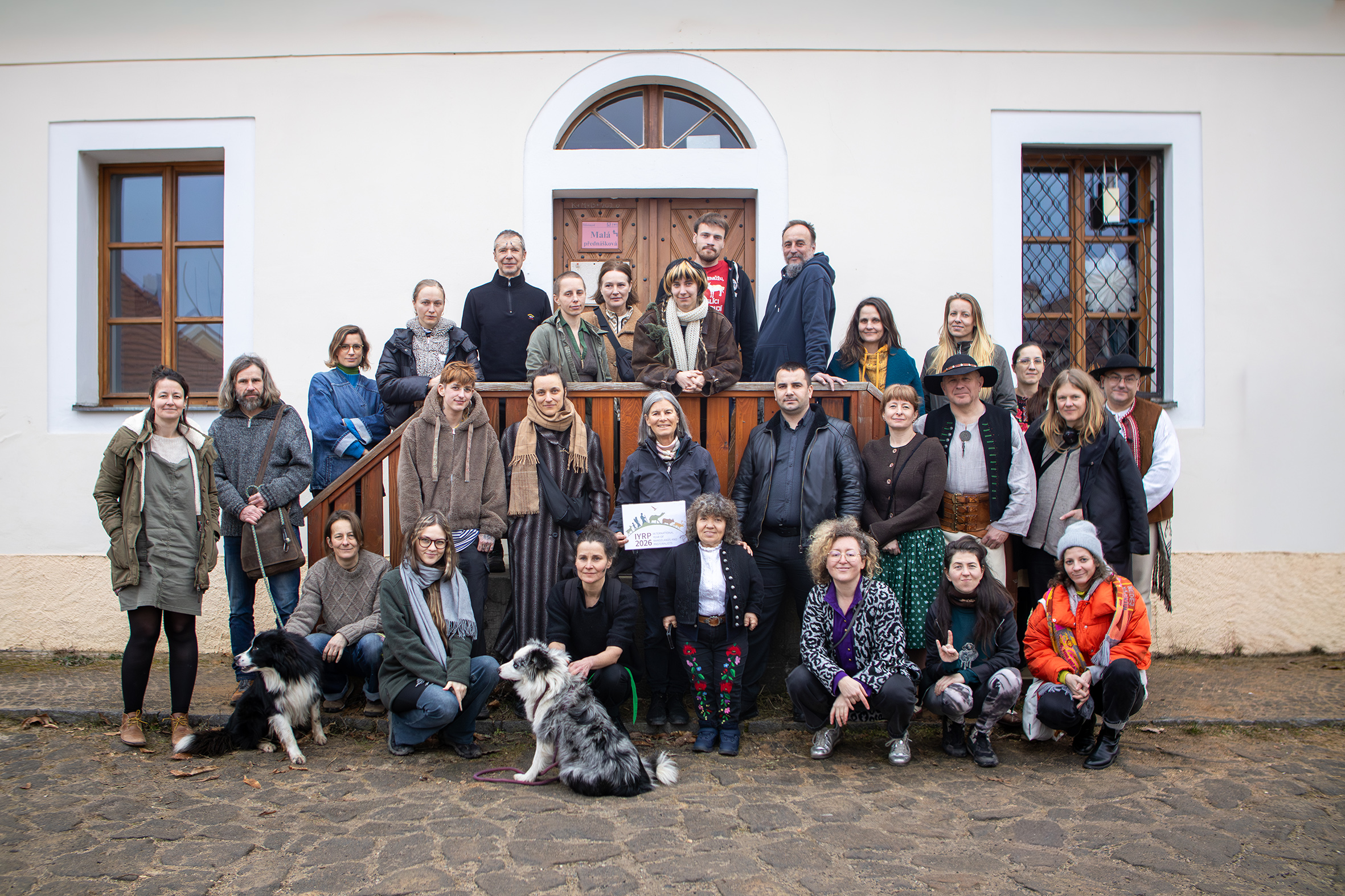
Eastern European Shepherd Convention from Pastoral Conspiracy, 6–8 February 2026:
The pastoral assembly, which gathered on the first weekend of February in the year 2026 at the former sheepfold at Toulcův Dvůr for an international conspiracy, arrived at several positions:
The pastoral vocation is home to a most diverse community, which nevertheless shares many common ideals.
The pastoral vocation may take many forms, which complement one another. Differences do not divide us; on the contrary, we recognize the importance of this diversity, for it allows us to respond to changing conditions and contexts of landscape, shepherdesses, shepherds, and animals.
The pastoral vocation is a life stance, a way of being, and by its very nature possesses a magical and cyclical character.
For the pastoral vocation, respect from society, peace on the land, and freedom of movement are essential.
The pastoral vocation requires ancient pastoral privileges to be honored, especially the use of paths, roads, hiking trails, and the landscape at large for the transfer of animals between grazing grounds.
The pastoral vocation is a profound knowledge of the land, a way of understanding and caring for the landscape. Through its actions it seeks to maintain and regenerate the land for generations to come, and thus—like other meritorious public services—ought to be valued by society and adequately financially compensated, so that shepherds may sustain not only themselves and their flocks, but also their families and loved ones.
In this regard, the pastoral vocation would also welcome minimal bureaucracy, so that it may devote itself to its work. And if some bureaucracy is necessary, then at least such that takes into account the unique nature of pastoral practice.
The pastoral vocation does not regard animals as mere means of production, but as unique beings with distinct needs, demands, opinions, and vices. Shepherds seek to build with them a welfare-based working relationship, or ideally a purely friendly one.
Good shepherds may be considered those who act through good practice. They know the expressions of a contented animal, how diverse grazing and appropriate pasturing ought to appear. They know how to care for the entire pasture community, not merely for their own profit, for they know how vital and yet how fragile are the ecosystems with which they are engaged.
The pastoral vocation contributes to maintaining biodiversity and to the resilience of the landscape in the face of a changing climate. Grazing preserves processes in the landscape on which it has long depended.
The pastoral vocation is practiced in the liminal worlds between cities, villages, and mountains; of states and polities; of human and more-than-human beings; between domestication and wildness; the real and the supernatural; conservation, healing, and banditry. Let us preserve the uniqueness of this liminal being.
The pastoral vocation is cultural heritage and tradition.
The pastoral vocation is alive and ever-adapting. On the pasture, knowledge blends with intuition and senses and instincts awaken. The millennia-old experience of shepherding cannot be reduced to technology. Data can refine it, but cannot replace decision-making that arises from the living landscape.
The pastoral vocation commits itself in manifold ways to spreading awareness of itself, and calls upon society to do likewise, thereby helping to create the conditions and space for the education of a young pastoral generation.
The pastoral vocation perceives wool as a gift.
The pastoral vocation is kind to animals, the landscape, and itself.
The pastoral vocation is open, curious, humble, and non-growth-oriented.
The pastoral vocation remains with its feet on the ground and its head in the clouds.
In Prague, 8 February 2026
anto_nie, Edith Jeřábková, Denisa Langrová, Ruta Putramentaite, Alex Sihelsk*, Kateřina Žák Konvalinová (Pastvina group, Czechia)
Michal Bažalík (Víno Bažalík, Slovakia)
Laura Garbštienė and Ugnė Venckė (Verpėjos, Lithuania)
Michaela Hyklová (Vlákna života, Czechia)
Zsófia Szonja Illés (artist and filmmaker, Hungary)
Ivana Kodajová (Vlčí Vrch, Slovakia)
Piotr and Maria Kohut (Fundacja Pasterstwo Transhumancyjne, Poland)
Petra Kutáčková (Hospodářství u kozy a petržele, Czechia)
Michal and Danuta Milerski (Nydecki Owieczki, Czechia)
Francesca Pasetti (Regional IYRP Support Group, Spain)
Ibolya Sáfiánné (Hungarian Women Herders, Hungary)
Martina Skohoutilová (Pražská pastvina, Czechia)
Martin Trávníček (Pestré Polabí, Czechia)
Jan and Vladislava Velík, Richard Souček (Farma Jana a Vladislavy Velíkových, Czechia)
Ivan Yatsko (Synevyr community, Ukraine)
Tomáš Zděblo (Jestřábník, Roztoky, Czechia)