

We Are Woods
26 July 2019, 1:00 a.m. — 28 July 2019, 11:56 p.m.
The first symposium on forest and meadow plot between the villages of Hnátnice and Písečná in the Orlické Mountains.
In 1973, a book appeared on the New York Times nonfiction bestseller list that proclaimed that plants are sentient beings with emotions, that they prefer classical music to rock ’n’ roll, and that they are capable of responding to people’s unspoken thoughts from hundreds of miles away. The Secret Life of Plants by Peter Tompkins and Christopher Bird presented an enchanting mixture of quack experiments and mystical nature rituals alongside legitimate plant science, and it captured the public imagination at a time when the New Age movement was seeping into mainstream thinking.
The most memorable passages described experiments by former CIA polygraph expert Cleve Backster, who in 1966 whimsically attached a galvanometer to the leaf of a dracaena, a houseplant he kept in his office. To his astonishment, Backster discovered that merely imagining the plant being exposed to fire was enough to make the plant raise the needle of the polygraph and register an increase in electrical activity, indicating that the plant was experiencing stress. The authors asked, “Could the plant read his mind?” Backster felt compelled to run into the streets and shout to the world, “Plants can think!” (Michael Pollan, “The Intelligent Plant,” The New Yorker, 15 December 2013.)
Our interest lies in paying attention to this decentralized mode of thinking and communication at a time when an ever-growing part of active society is striving to undermine hierarchical arrangements and to take responsibility for climate change on our planet. While Australian biologist Monica Gagliano has presented a number of convincing experiments demonstrating plants’ cognitive abilities—including perception, learning, memory, and consciousness—her opponents, such as California botanist Lincoln Taiz, argue that plant neurobiology is driven by the environmental crisis, which represents a growing threat to life on Earth.
We imagine the forest as a communicating and cooperating community of organisms of different species, and we want to collectively (re)learn this language and thus find a way to save our relationships and lives on Earth.
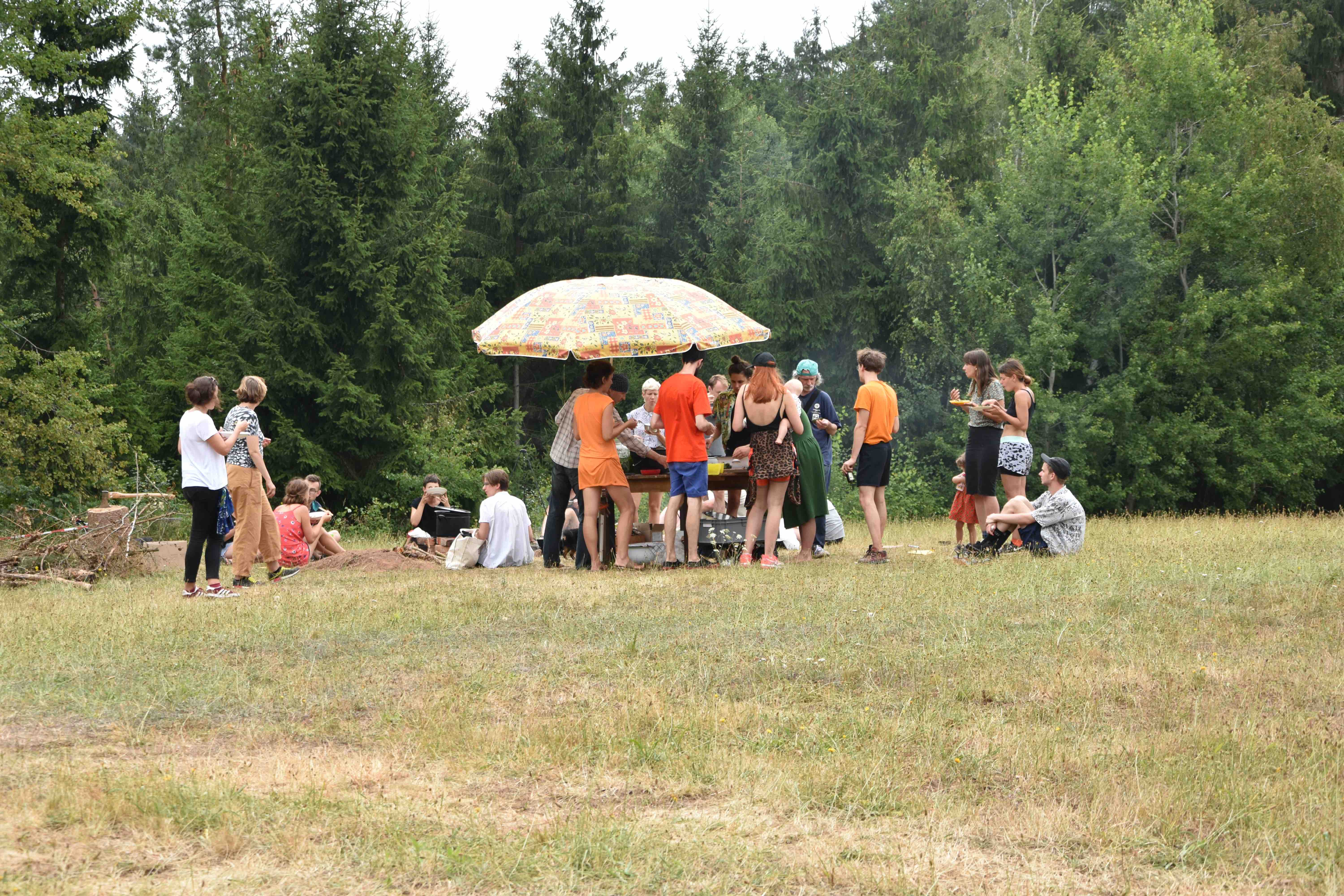
Join us—artists, theorists, curators, sociologists, experts on plants and stars—over the weekend of 26–28 July to talk, look, listen, cook, eat, and be among others in a forest that we have taken out of commercial management and dedicated to the shared exploration of our interconnected existence.
The program was prepared by Zuzana Blochová, Edith Jeřábková, Barbora Kleinhamplová, Adéla Korbičková, Eva Koťátková, and Tereza Porybná.
Contributors to the program include herbalist Vendula Litterová; curators Borbála Soós, Karina Kottová, Tereza Jindrová, and Veronika Čechová; curator Piotr Sikora; actress Sára Jan Märcová; film theorist Tereza Castro; Jožka Čermák and Petr Prokeš, founders of the PagoPago Association; artists Anetta Mona Chişa, Jiří Kovanda, David Fesl, Denisa Langrová, Ruta Putramentaite, David Střeleček, Jonáš Richter, Matěj Pavlík, and Jan Kolský; theorist Vojtěch Märc; and sociologist Tereza Stöckelová.
PROGRAM
Throughout all three days, the construction of an insect hotel will take place in parallel—a work by artists Denisa Langrová, Ruta Putramentaite, and David Střeleček. Using found natural materials and recycled matter, the artists will create an environment in which insects can settle and reproduce. At the same time, the surrounding area of the insect shelter will become a place for encounters between humans and these small companions.
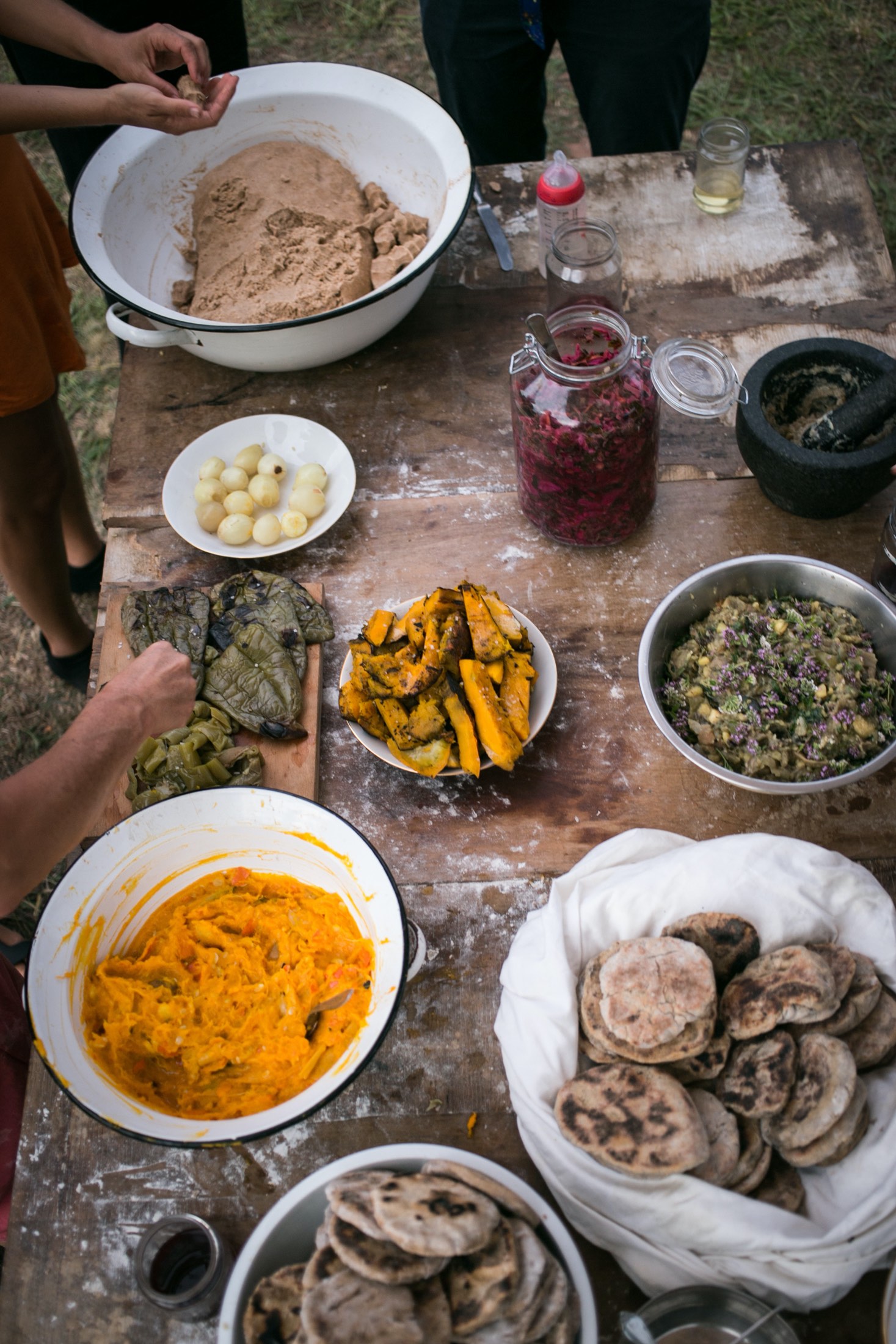
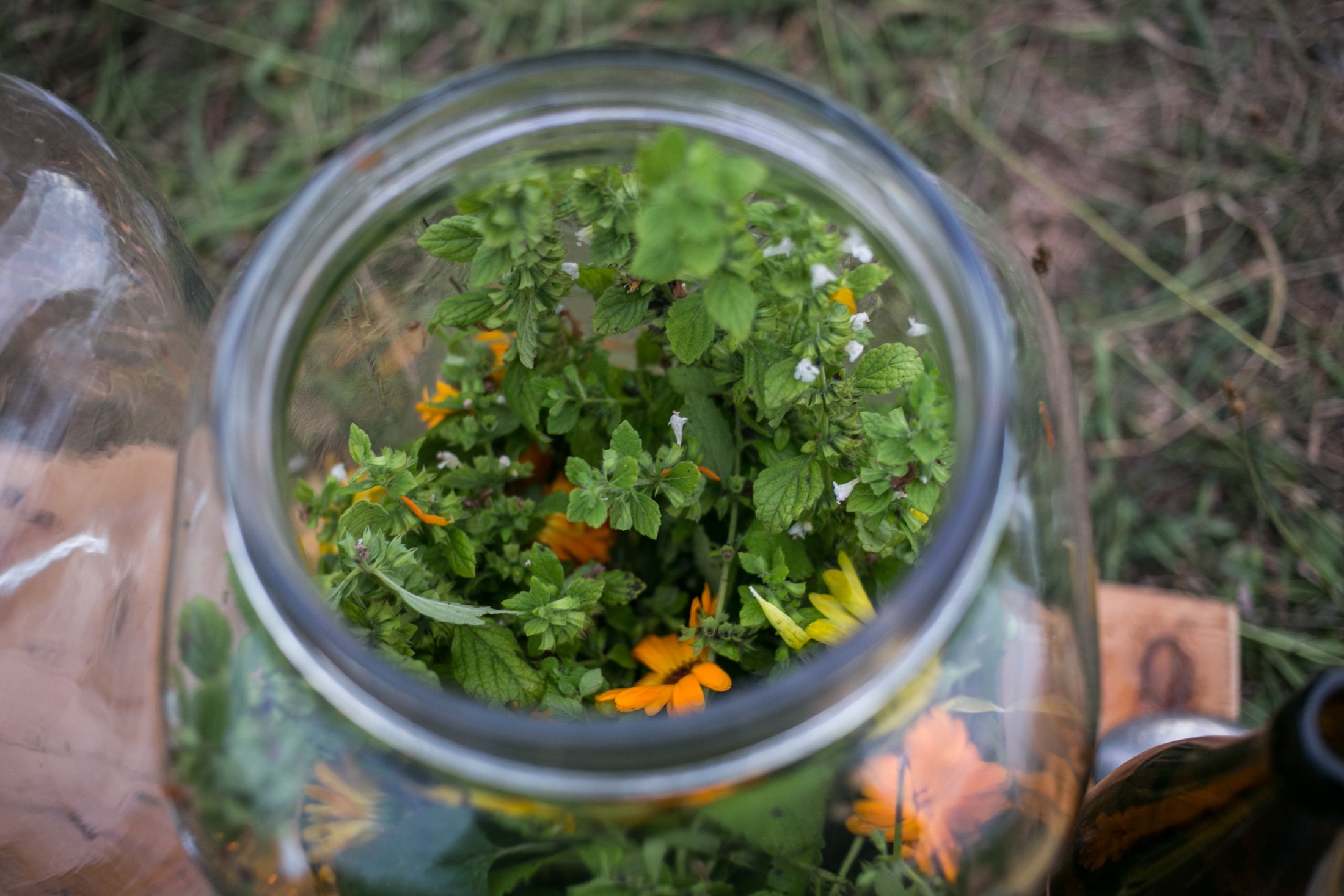
Forest Kitchen, where each day Zuzana Blochová, Adéla Korbičková, and David Fesl will prepare a menu from local herbs and plants, homemade products, and ingredients from the surrounding nature. The Forest Kitchen draws inspiration from recipes and original methods more than a hundred years old: fermentation, leaching, baking in the ground, and more.
26 July / FRIDAY
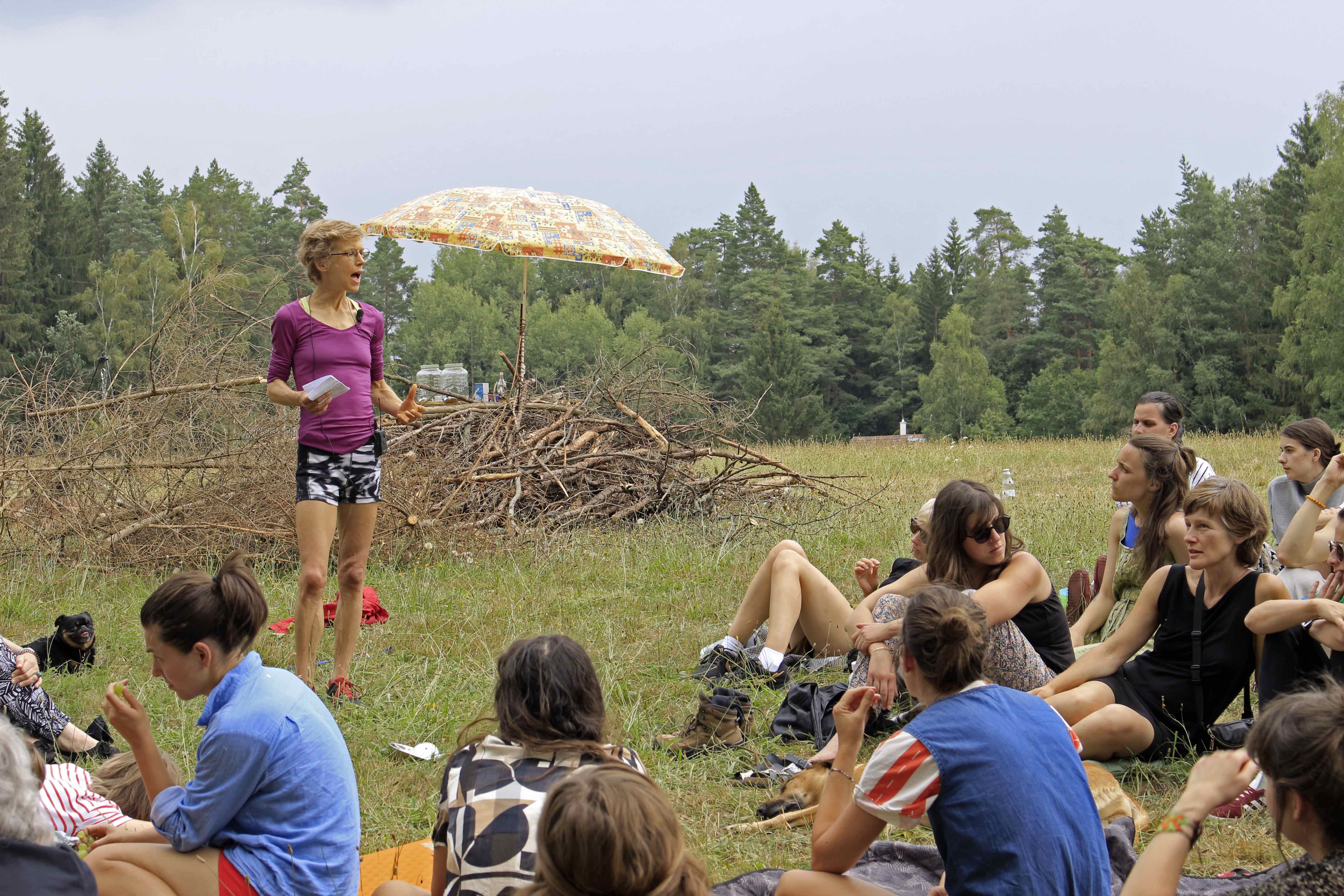
18:00 – Vendula Litterová: On Herbs and Their Healing Effects
You can read about the effects of herbs in many books. But do you know how and where to look? How to learn to recognize herbs—not just approximately, but precisely the one you need—and how to seek out the right ones? A short lecture combined with a gentle walk around the area.
19:00 – Forest Kitchen: Dinner
21:00 – Vendula Litterová: Performative Lecture
Herbalism is not merely pure botanical materialism. The herbal craft is a combination of materialism and spiritual practice. An introduction to the topic and a shared meditation on “Connecting with the Spirit of the Plant,” or how to cultivate friendly relationships and gain information from plant spirits.
22:00 – Anetta Mona Chişa: Nothing Nowhere into Something Somewhere
The telling of the story of the fly agaric (Amanita muscaria), which people have associated with the supernatural, alternative realities, and shamanic practices since time immemorial. It is one of the oldest known hallucinogenic delicacies, also called Soma, and has inspired various myths, legends, and fairy tales. Nothing Nowhere into Something Somewhere (2015) is a story in which, together with Lucia Tkáčová, we dissolved and filtered the psychoactive compounds of Amanita muscaria through our bodies and precipitated them into edible sculptures. Inspired by the practices of ancient seekers of knowledge and their guides, the solidified, shaped mind-altering liquid was exhibited in galleries and offered to visitors as an invitation to participatory learning of mind and body.
23:00 – Petr Prokeš: On the Intelligence of the Universe and Its Influence on Plants and Nature
Lecture.
27 July / SATURDAY
9:00 – Forest Kitchen: Breakfast
10:30 – Borbála Soós: Interspecies Relationships: How to Speak with Birds?
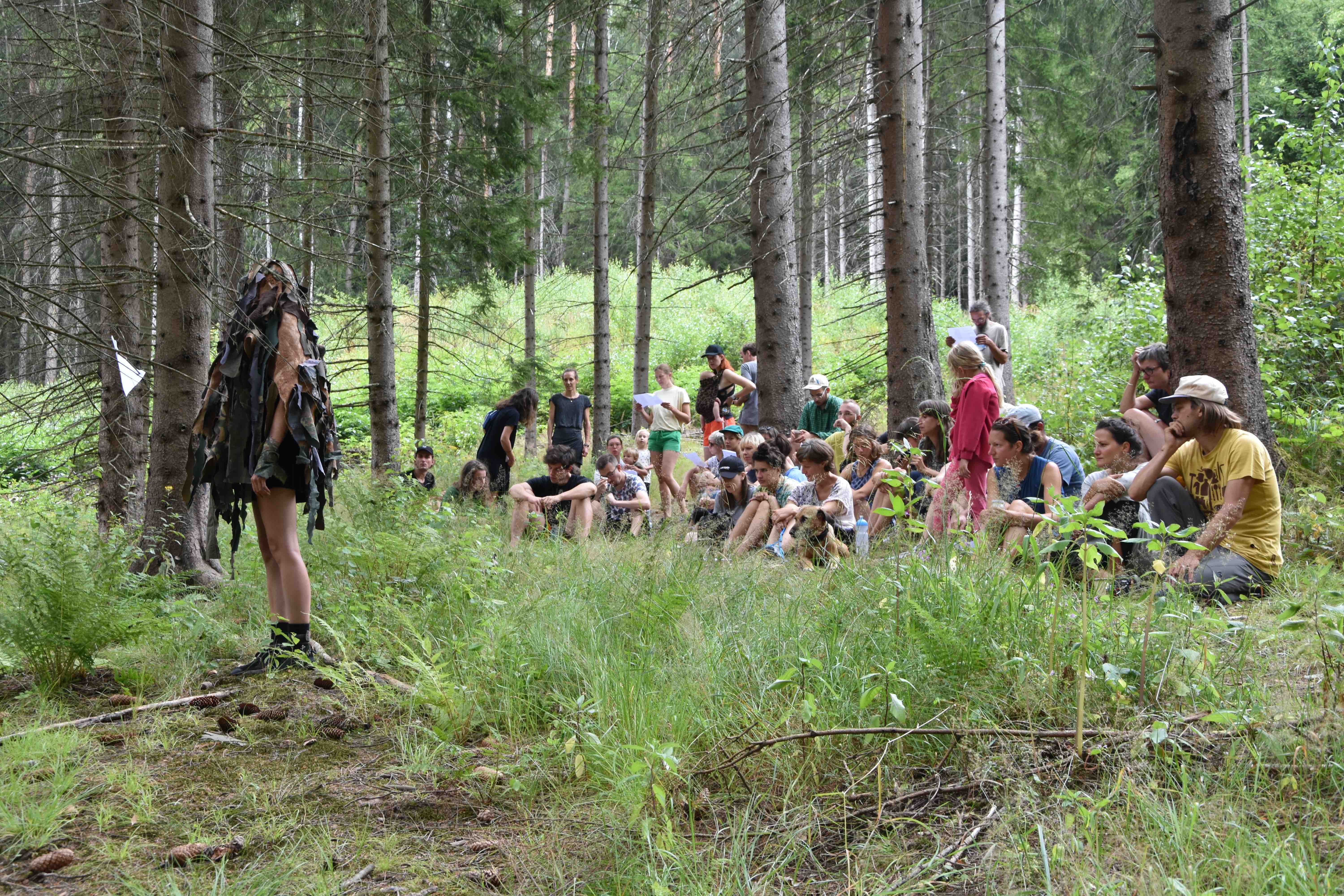
A performative lecture that unfolds in various phases as a walk in the forest, addressing the impact of scientific and philosophical representations of birds on our relationship with them. The forest excursion and the overlapping of natural and social systems also open space for imagination and visions of other modes of being of our own species. When we look at ourselves through the eyes of other living beings with whom we share the world, we begin to understand how our fate is bound to theirs—socially, economically, and ecologically.
Humanity has historically been intertwined with birds, as evidenced by our vocabulary and methods of communication. Birds have been objects of our individual and collective hopes, anxieties, and interests. Interspecies relationships take place on the levels of beloved pets, overlooked pests, laboratory objects, and collaborators. They include breeding hobbies and, of course, the dominant relationship of hunter and prey (in both directions). Animals are powerful figures in biopolitical terms; their perception has played an important role in controlling human populations and in our understanding of the relationship between nature and culture.
Borbála Soós is a Hungarian curator based in the United Kingdom. In 2002 she completed curatorial studies at the Royal College of Art in London. She also studied film studies and art history at Eötvös Loránd University in Budapest. From 2012 to 2019 she was director and chief curator of the London contemporary art gallery Tenderpixel. She frequently lectures or organizes workshops and seminars at Goldsmiths College, the Royal College of Art, Central Saint Martins, and other universities. Her recent theoretical work focuses on developing natural structures and examining them as metaphors for social organization. In this context, she has curated numerous exhibitions and projects related to the study of plants and animals, biopolitics, natural resources, and systemic dynamics.
12:00 – Matěj Pavlík, Jan Kolský, Vojtěch Märc
A listening session devoted to interspecies communication, particularly communication between humans and plants through music. Alongside selected compositions, fragments from the history of related research will be presented, partly in relation to the question of plant intelligence.
13:00 – Forest Kitchen: Lunch
15:00 – Tereza Stöckelová: Metabolic Citizenship: An Attempt at a Digestif
Tereza Stöckelová will offer several theses for a debate on what the concept of (forest) “community” conceals and obscures. How would the notion of citizenship change if we included plant life within it? How can we avoid co-evolutionary racism?
Tereza Stöckelová studied sociology and works in the field of science, technology, and medicine studies. Her thematic focus includes contemporary transformations of research and education, the movement of knowledge between science and society, and issues of political ecology. She currently researches conflicts, connections, and interfaces between conventional medicine and alternative therapeutic practices. Her work draws on actor-network theory and related material-semiotic approaches and employs qualitative, ethnographic methods.
16:00 – Sára Jan Märcová
In 1907, Maurice Maeterlinck published an essay entitled The Intelligence of Flowers, in which he not only addresses plants as if they were conscious organisms, but also considers the position of humans in relation to other living beings and the Universe. A reading of selected passages will be accompanied by an exploratory musical research project aimed at investigating the performative capacities of plants. The experiment is open to the opinions and actions of the audience.
17:00 – Jožka Čermák (Pago Pago Association): Sustainable Forest Management
Lecture.
20:00 – Forest Kitchen: Dinner
21:00 – Karina Kottová and Piotr Sikora: Mixed Forest: Art Institutions from the Perspective of Flora
A performative bedtime lecture.
22:00 – Tereza Castro: Cinematic Forests
A lecture by Tereza Castro with film excerpts.
The forest is a privileged space for all kinds of fantasies and has enriched the cinematic imagination since the beginnings of film. The lecture “Cinematic Forests” allows us to immerse ourselves aurally and visually in some of these cinematic forests—especially those that appear as places of refuge and knowledge, and those that represent “communities of the possible” connecting human and more-than-human species.
Tereza Castro teaches in the Department of Film Studies at Université Sorbonne Nouvelle – Paris 3. She completed postdoctoral research fellowships at the Quai Branly Museum in Paris and the Max Planck Institute in Berlin. She has published articles and books on a wide range of topics, including the relationship between film and cartography (La pensée cartographique des images. Cinéma et culture visuelle, Lyon, Aléas, 2011) and (post-)colonial cinema (co-editor of Re-Imagining African Independence. Film, Visual Arts and the Fall of the Portuguese Empire, Oxford, Peter Lang, 2017). She is currently writing a monograph on forests in cinema and collaborating on an edited volume on the power and agency of the plant world (film, visual culture, anthropology).
23:00 – Forest Cinema
Program curated by Borbála Soós, Tereza Castro, and biologist, geneticist, and educator Fatima Cvrčková.
28 July / SUNDAY
9:00 – Forest Kitchen: Breakfast
10:30 – Denisa Langrová, Ruta Putramentaite, and Jonáš Richter: Blending in Choir
A happening inviting all participants to attune themselves to the vibrations of the forest’s acoustic situation. Through collective singing, we will attempt to merge with nature while also reflecting on the various colonizing aspects of this process.
11:00 – Honza Dlabal: Meditation
13:00 – Tereza Jindrová and Veronika Čechová: We Have Never Been Individuals
14:00 – Jiří Kovanda: Every Cornflower Is Smarter Than Me
15:00 – Forest Kitchen: Lunch
Photodocumentation: Dita Lamačová a Stan Baranski
Support: Ministry of Culture of the Czech Republic; GTL; Atanasios Iliopulos; Solid Sun; PROBIO; Svobodný statek na soutoku; VELTLIN.
Ingredients provided by: PROBIO; Svobodný statek na soutoku; VELTLIN; Dobrá farma; Ekofarma Horní Ředice; Ranč Bělečko.
Acknowledgements: The Emblem Hotel; Mirek, Pavlína, and Jaromír Verbík; Radim Patkolo; Dita Lamačová; Celine Duval; Václav Girsa; Michal Boška.
Organised with financial support from the City of Prague, the Ministry of Culture of the Czech Republic, Prague 7 Municipal District, and the State Culture Fund.